
 Por Marcela Sánchez
 - Este ejercicio se centra en la voz pasiva en inglés.
- La voz pasiva se forma con el verbo “to be” seguido del participio pasado del verbo principal.
- Se presenta una serie de oraciones que deben ser transformadas a la voz pasiva.
- Al hacerlo, comprenderás cómo se construye la voz pasiva en diferentes tiempos verbales.
- Se te invita a identificar el sujeto y el objeto de cada oración.
- Se ofrecen recursos adicionales, como infografías, sobre la voz pasiva en inglés.
- Las infografías cubren la formación, el uso y la conjugación de la voz pasiva.
- Al completar el ejercicio, mejorarás tu comprensión de la voz pasiva.
- Podrás identificar cuándo utilizar la voz pasiva y cómo construirla correctamente.
- Esto te ayudará a escribir con mayor precisión y fluidez.
- La voz pasiva enfatiza la acción más que al sujeto.
- Es útil cuando el sujeto es desconocido o irrelevante.
- La voz pasiva da un tono más formal.
- Se utiliza en textos académicos y profesionales.
- La voz pasiva se puede utilizar para evitar la repetición.
- La voz pasiva es una herramienta poderosa en el idioma inglés.
- Te permite variar tu estilo de escritura y comunicar ideas de manera más efectiva.
- Este ejercicio te ayudará a dominar la voz pasiva.
- Podrás utilizarla con confianza en tus escritos.
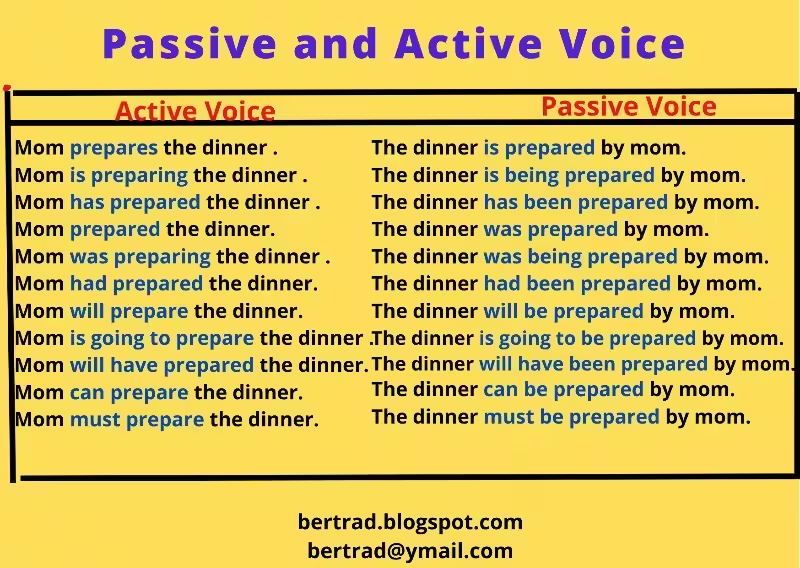
Mastering the active and passive voice in English is crucial for effective communication. The active voice emphasizes the subject performing the action, while the passive voice highlights the object receiving the action. This article will be your guide through the world of passive voice, providing you with exercises to solidify your understanding and practice its application.
Understanding the Passive Voice
The passive voice is formed using the verb “to be” in the appropriate tense followed by the past participle of the main verb. For instance, “The dog chased the cat” (active voice) becomes “The cat was chased by the dog” (passive voice).
The passive voice is employed in various situations, often when the object of the action is more significant than the subject. Consider the sentence, “The building was built in 1950.” Here, the focus is on the building and its construction, not the actual builder.
Exercises to Sharpen Your Skills
Fill in the Gaps
This section presents sentences with blank spaces. Your task is to complete these sentences using the correct passive voice form.
Remember that there can be multiple correct answers depending on the context. Consult the solutions provided at the end to verify your responses.
- The letter ______ (write) yesterday.
- The car ______ (repair) at the moment.
- The game ______ (play) by the best team.
- The news ______ (announce) on television.
- The book ______ (read) by many people.
Active to Passive
This exercise involves transforming active voice sentences into passive voice. Follow the provided example to guide you through the process.
Remember that in the passive voice, the agent performing the action can sometimes be omitted if it is not relevant.
Example: The baker made the cake. –> The cake was made (by the baker).
- The teacher explained the lesson.
- My father built this house.
- The artist painted the masterpiece.
- The dog ate the bone.
- They cancelled the flight.
Solutions
Fill in the Gaps
- The letter was written yesterday.
- The car is being repaired at the moment.
- The game is played by the best team.
- The news was announced on television.
- The book has been read by many people.
Active to Passive
- The lesson was explained by the teacher.
- This house was built by my father.
- The masterpiece was painted by the artist.
- The bone was eaten by the dog.
- The flight was cancelled.
Practice Makes Perfect
Continue practicing the active to passive voice transformation by identifying passive voice structures in various texts.
Try converting simple sentences from your reading materials into passive voice. Use guides or online resources to ensure your transformations are accurate.
Remember, mastering the passive voice is a journey, not a destination. With consistent practice, you will become confident in using this powerful grammatical tool in your writing and communication.
Preguntas Frecuentes sobre Ejercicios de Voz Pasiva en Inglés
¿Qué tipo de ejercicios se incluyen en el material?
El material incluye dos secciones principales de ejercicios: “Fill in the gaps” y “Active to passive”.
¿Qué se debe hacer en la sección “Fill in the gaps”?
En esta sección, debes completar oraciones con espacios en blanco usando la voz pasiva en el tiempo verbal correcto.
¿Qué se debe hacer en la sección “Active to passive”?
En esta sección, debes transformar oraciones de voz activa a voz pasiva.
¿Hay soluciones para los ejercicios?
Sí, las soluciones se proporcionan al final del material.
¿Es necesario saber cómo formar la voz pasiva para hacer los ejercicios?
Sí, se asume que el lector ya tiene conocimiento sobre la formación de la voz pasiva en inglés.
¿Hay recursos adicionales para aprender sobre la voz pasiva?
Sí, el material ofrece recursos adicionales como infografías que explican la formación, el uso y la conjugación de la voz pasiva en diferentes tiempos verbales.
¿Qué beneficios tiene comprender la voz pasiva?
Comprender la voz pasiva te permite variar tu estilo de escritura, enfatizar la acción en sí misma y utilizar un tono más formal en tu comunicación.


