
 Por Marcela Sánchez
 - Identifica el objeto de la acción en la oración activa.
- Utiliza la forma correcta del verbo “to be” en el tiempo verbal deseado (presente simple, pasado simple, etc.).
- Añade el participio pasado del verbo principal.
- Si es necesario, incluye la frase “by + agente” para indicar quién realiza la acción.
- Practica la transformación de oraciones de la voz activa a la pasiva para mejorar tu comprensión y fluidez.
- Utiliza la voz pasiva cuando quieras enfatizar la acción o el objeto de la acción.
- Recuerda que la voz pasiva se considera más formal que la activa.
Have you ever wondered why some sentences sound more formal or emphasize a specific action? The answer might lie in the passive voice! It’s a powerful tool in English grammar, particularly when you want to shift focus from the doer of an action to the receiver of that action. Imagine you’re reading a news report about a robbery. Instead of saying “The thief stole the jewels,” you might see “The jewels were stolen.” This subtle shift in structure changes the emphasis, highlighting the jewels rather than the thief.
In this article, we’ll dive into the passive voice in present and past simple tenses, exploring its structure, usage, and how to transform active sentences into passive ones. Let’s get started!
Understanding the Passive Voice
The passive voice is a grammatical construction where the object of the verb becomes the subject of the sentence. We use it when the action is more important than who is performing it. Let’s break down the key elements:
Key Differences from Active Voice
The passive voice differs from the active voice in several crucial ways:
- Subject: In the active voice, the subject performs the action. In the passive, it’s the receiver of the action.
- Verb: We form the passive voice using the verb “to be” in the appropriate present or past tense, followed by the past participle of the main verb.
- Agent: The original subject of the active sentence (the one performing the action) can be included in the passive sentence using the preposition “by” (e.g., “The book was written by Jane Austen”).
Structure of the Passive Voice
Here’s how you can build passive voice sentences in present and past simple tenses:
Present Simple Passive:
- Structure: Object + IS/ARE/AM + Past Participle + (by + Agent)
- Example: The cake is eaten by us. (Active: We eat the cake.)
Past Simple Passive:
- Structure: Object + WAS/WERE + Past Participle + (by + Agent)
- Example: The house was built by the carpenter. (Active: The carpenter built the house.)
When to Use the Passive Voice
The passive voice is not a replacement for the active voice; it’s a powerful tool for specific situations. Here are some common scenarios where it shines:
- Formal Writing: The passive voice lends a formal tone, often used in academic writing, reports, and news articles.
- Focus on the Action: If the action itself is more central to the message than the actor, the passive voice emphasizes that action.
- Unknown or Unimportant Actor: The passive voice is helpful when the actor is unknown or unimportant. For example, “The window was broken” implies the culprit is unknown.
- Common Phrases: Some actions are naturally expressed in the passive voice, like “born” (“I was born in 1990”).
Exercises: Putting the Passive Voice into Practice
Now, let’s put your knowledge into action! The following exercises will help you master the transformation from active to passive voice:
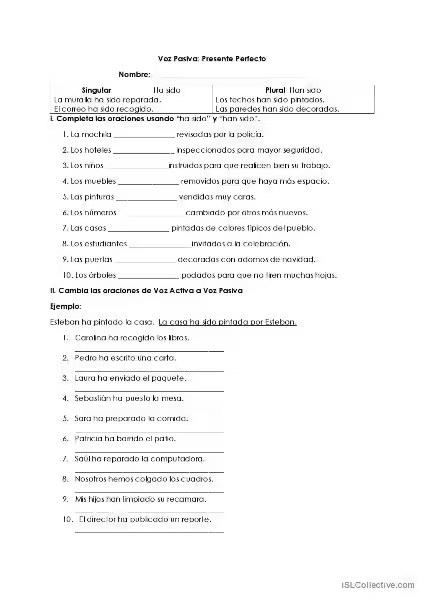
- Active to Passive: Convert the following sentences from active to passive voice:
- The teacher corrected the students’ essays.
- The chef prepared a delicious meal.
- They delivered the package yesterday.
- Passive to Active: Convert the following sentences from passive to active voice:
- The car was repaired by the mechanic.
- The game was won by the home team.
- The book was read by thousands of people.
Conclusion: Mastering the Passive Voice
Understanding the passive voice is a crucial step in mastering English grammar. By recognizing when to use it, how to form it, and how to shift between active and passive voice, you’ll gain a more nuanced understanding of the language and be able to express yourself with greater clarity and precision. Remember, practice makes perfect! Continue to explore the passive voice through reading, writing, and speaking, and you’ll soon find it a valuable tool in your English communication arsenal.
¿Qué es la voz pasiva en inglés?
La voz pasiva en inglés se utiliza cuando queremos enfatizar la acción en lugar del sujeto que la realiza. Por ejemplo, en la oración “The window was broken by John”, la atención se centra en la ventana, no en John.
¿Cómo se forma la voz pasiva en inglés?
La voz pasiva se forma utilizando el verbo “to be” en la forma correspondiente al tiempo (presente o pasado) seguido del participio pasado del verbo principal.
¿Cuándo se utiliza la voz pasiva en inglés?
La voz pasiva se utiliza en inglés cuando queremos:
- Enfatizar la acción en lugar del sujeto que la realiza.
- Dar un tono más formal al lenguaje.
- Omitir el sujeto que realiza la acción cuando no es importante o se desconoce.
¿Cómo puedo practicar la voz pasiva en inglés?
Puede practicar la voz pasiva en inglés utilizando ejercicios que le pidan que cambie oraciones de la voz activa a la pasiva o viceversa. También puede leer textos en inglés y observar cómo se utiliza la voz pasiva en diferentes contextos.
¿Cuáles son algunos ejemplos de oraciones en voz pasiva en inglés?
Aquí hay algunos ejemplos de oraciones en voz pasiva en inglés:
- The door was opened by the key.
- The cake was eaten by the children.
- This book was written by a famous author.


